> ## Documentation Index
> Fetch the complete documentation index at: https://docs.imagine.art/llms.txt
> Use this file to discover all available pages before exploring further.
# Scheduled Tasks
> Set an agent task to run on a repeat, instead of triggering it yourself every time.
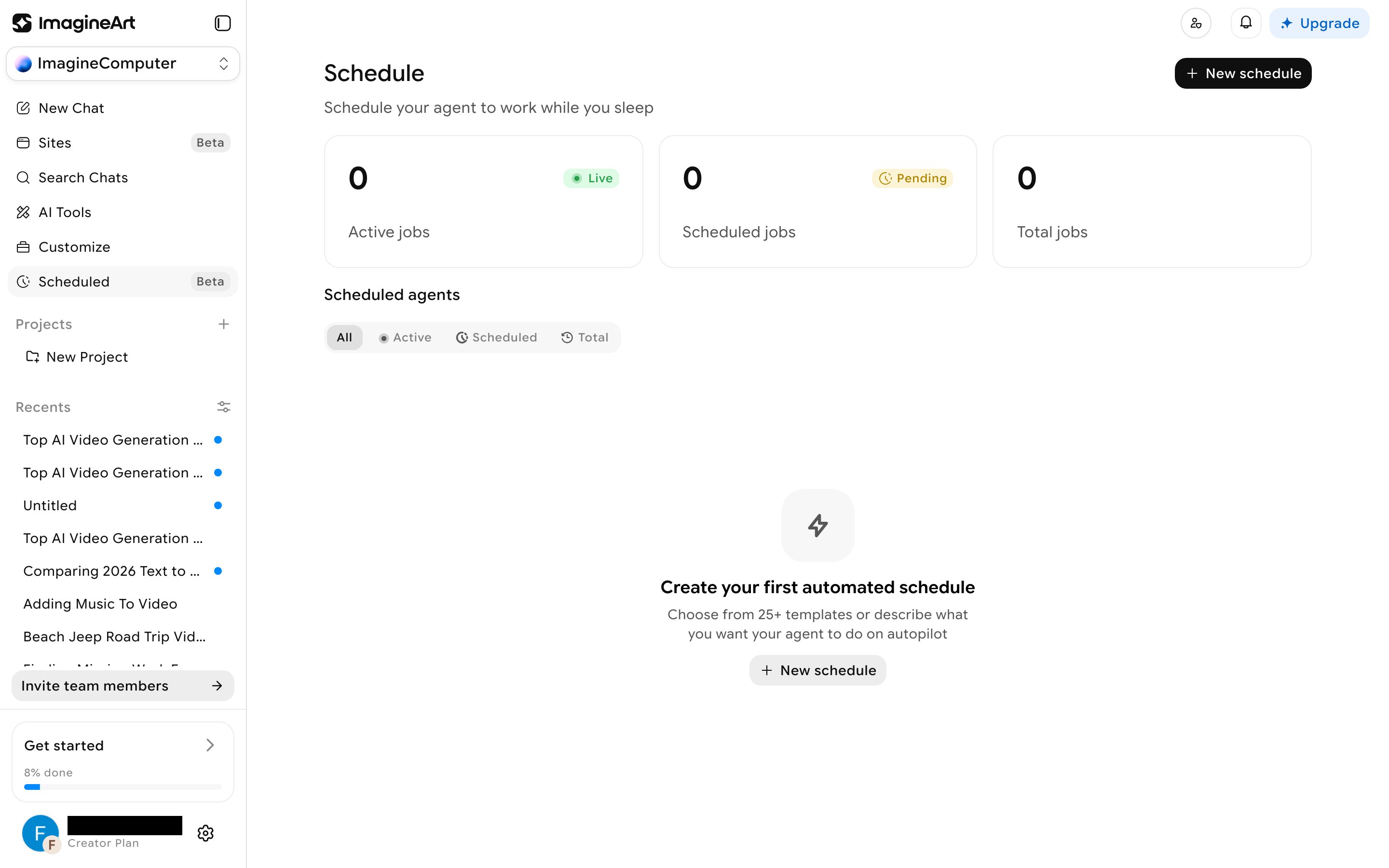
**Scheduled** *(Beta)*, in the sidebar, turns a one-off agent task into a recurring job.
Click **Scheduled** in the sidebar. It tracks **Active**, **Pending**, and **Total** job counts, and lists your scheduled agents below.
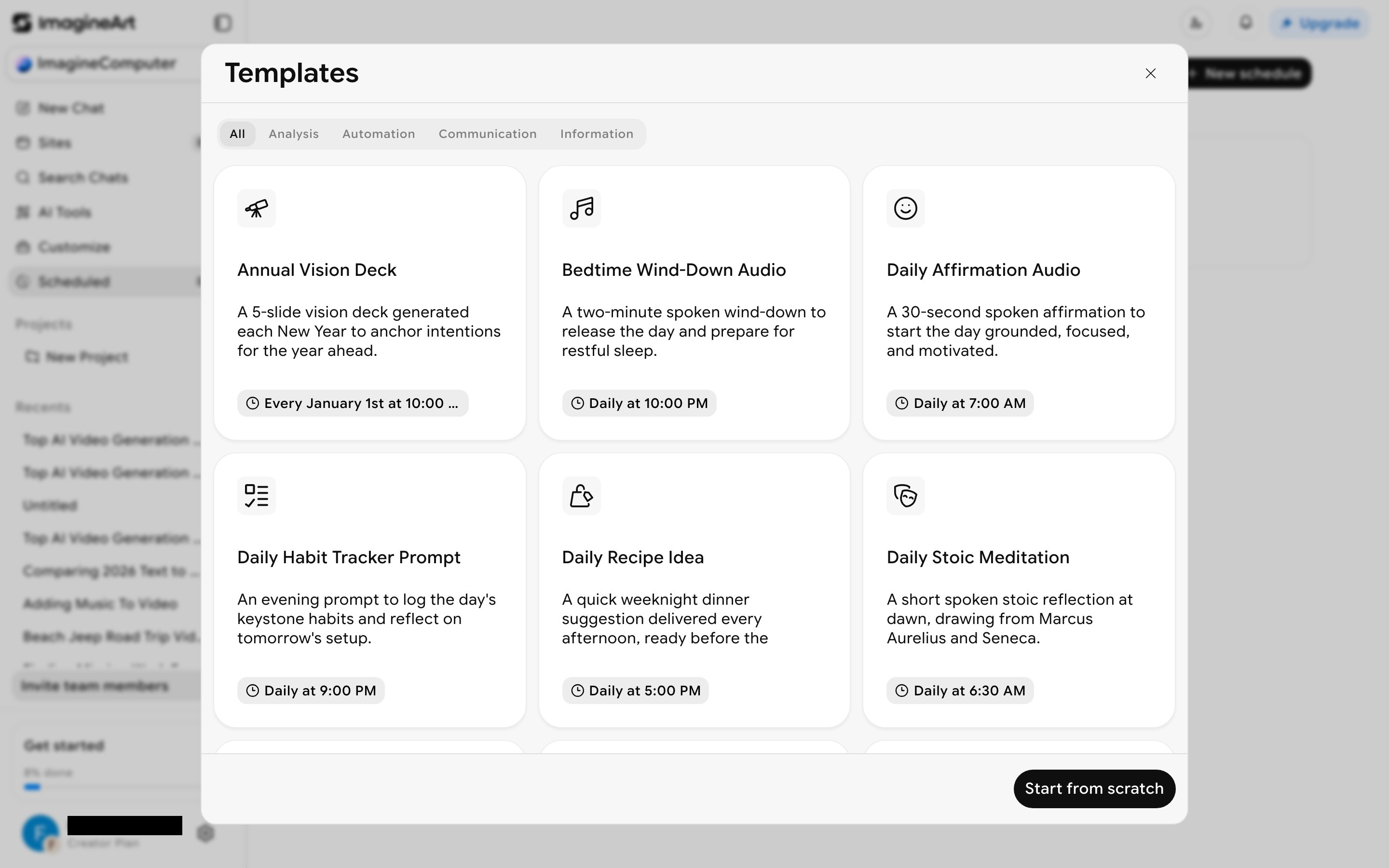
 Click **New schedule** to open a template gallery — over 24 real, named templates (Annual Vision Deck, Bedtime Wind-Down Audio, Daily Affirmation Audio, Daily Habit Tracker Prompt, and more), filterable by **Analysis**, **Automation**, **Communication**, and **Information**. Each template shows its own default schedule (e.g. "Daily at 7:00 AM"). Click **Start from scratch** if none fit.
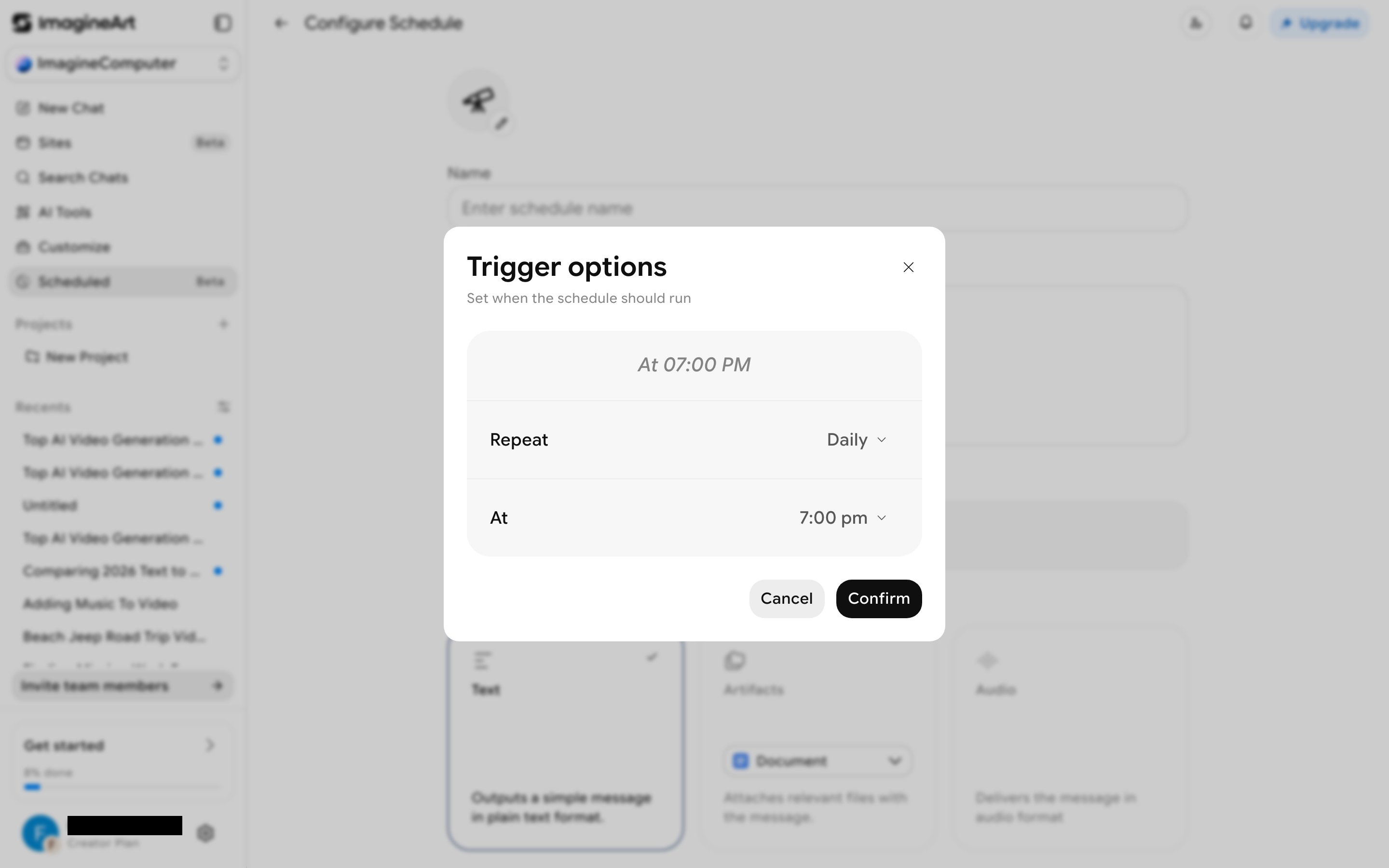
 Fill in a **Name** and **Task description**, then set the **Trigger** — click it to open **Repeat** options (Run once, Daily, Daily on weekdays, Weekly, Monthly, Quarterly, Annually, or Custom) and a time picker. No raw cron syntax is exposed.
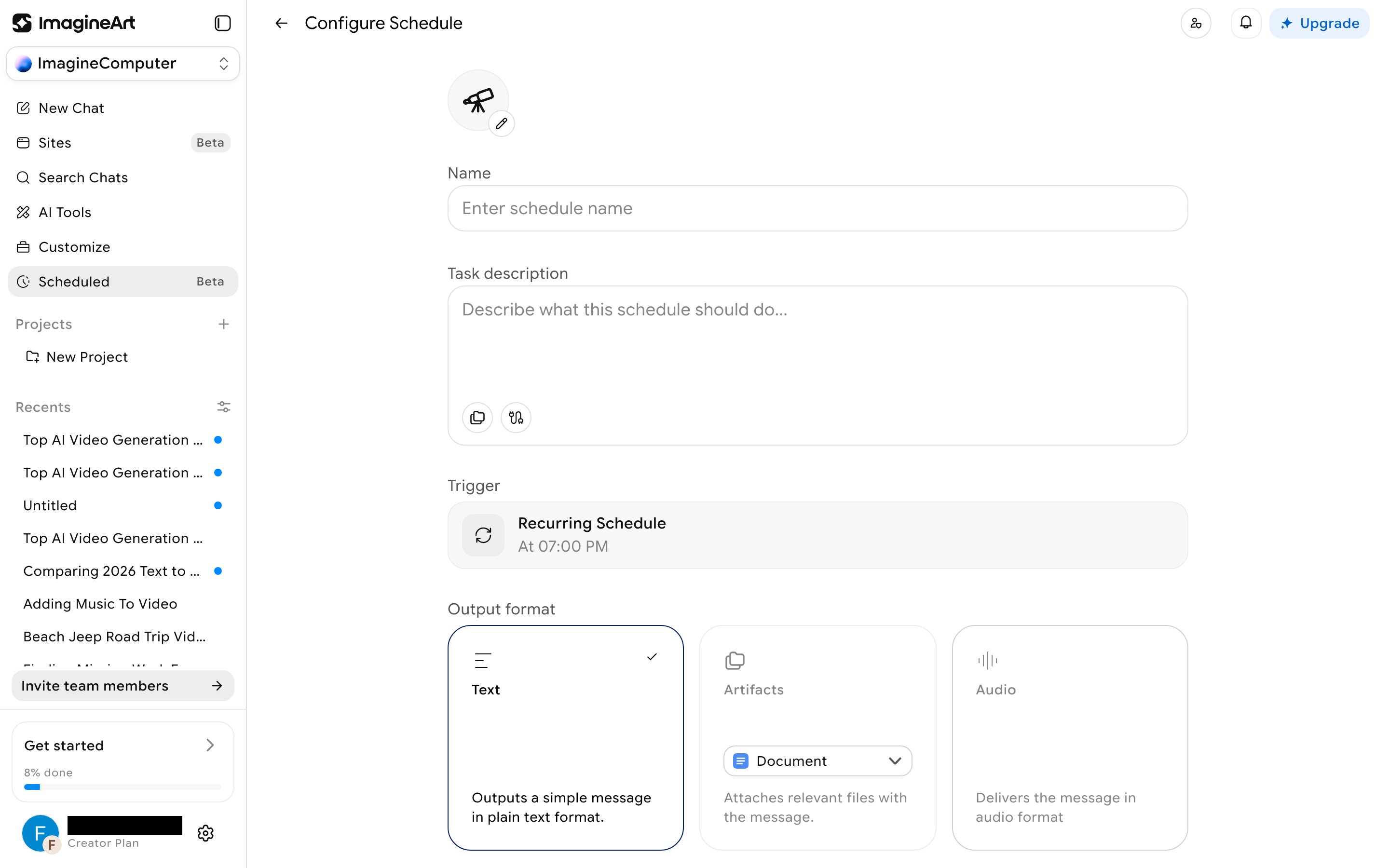
 Choose an **Output format** — **Text** (a simple plain-text message), **Artifacts** (attaches relevant files, e.g. a Document), or **Audio** (delivers the message as speech) — and an **Output destination**: the default in-Computer chat, a Slack channel, a Slack DM, or Gmail.
Templates are a faster starting point than they look — even if the exact use case doesn't match yours, copying a template's trigger/output setup and swapping the task description is quicker than configuring everything from scratch.
Choose an **Output format** — **Text** (a simple plain-text message), **Artifacts** (attaches relevant files, e.g. a Document), or **Audio** (delivers the message as speech) — and an **Output destination**: the default in-Computer chat, a Slack channel, a Slack DM, or Gmail.
Templates are a faster starting point than they look — even if the exact use case doesn't match yours, copying a template's trigger/output setup and swapping the task description is quicker than configuring everything from scratch.